centilio
Centilio

Explore the products

A business OS.
Room to grow.

Start with one tool. Explore the wider suite as your needs grow.

Explore Centilio One ↗Product availability follows the catalogue.
Centilio SignFeatherstroke
FREE TEMPLATE / GOVERNMENT, TAX FORMS AND STAMP DUTY

Substitute Form W-9, Request for Taxpayer Identification Number and Certification

Your organisation's own version of IRS Form W-9 for a US contractor, vendor or other payee. The payee types their own name, federal tax classification, address and taxpayer identification number, then signs the IRS certification under penalties of perjury. Nobody at your organisation types the payee's number.

For the United States.

The PDF is free to download. Centilio Sign is free to start.

GOVERNMENT, TAX FORMS AND STAMP DUTY / FREE TEMPLATERequest for Taxpayer Identification Number and CertificationRequesterRequesterRequester's addressRequester's addressSignature of U.S. personSignature: Ready
PDF, 3 pages, 17 KB
THE DOCUMENT

Read it, fill it in, print it

The whole document, exactly as it prints. Type your answers and they appear in the document as you go. When it reads right, print it or save it as a PDF.

Request for Taxpayer Identification Number and Certification

Substitute Form W-9, following IRS Form W-9 (Rev. March 2024). The payee fills in the lines that apply and signs. It goes to the requester named below and is not sent to the IRS. Template v1.0.

Requester: Requester

Requester's address:

Requester's address

The requester needs your correct taxpayer identification number (TIN) to report payments to you to the IRS, and to know whether backup withholding applies. The requester gives you the IRS instructions for this form if you ask.

Payee information

Line 1 is required. A sole proprietor or a disregarded entity gives the owner's name on line 1 and the business or disregarded entity name on line 2.

1. Name of entity or individual: Payee fills this in when signing

2. Business name, if different from line 1: Payee fills this in when signing

Line 3a: write one federal tax classification for the person or entity on line 1, chosen from these seven: Individual/sole proprietor, C corporation, S corporation, Partnership, Trust/estate, LLC with its tax classification (C for C corporation, S for S corporation, P for partnership), or Other with a short description. An LLC that is a disregarded entity gives the classification of its owner instead.

3a. Federal tax classification: Payee fills this in when signing

3b. Tick this box if line 3a is Partnership, Trust/estate, or LLC with classification P, you are giving this form to a partnership, trust or estate in which you have an ownership interest, and you have any foreign partners, owners or beneficiaries. Payee

Line 4: the exemption codes apply only to certain entities, not to individuals. The FATCA code applies to accounts kept outside the United States. See the IRS instructions for Form W-9.

4. Exempt payee code, if any: Payee fills this in when signing

Exemption from FATCA reporting code, if any: Payee fills this in when signing

5. Address (number, street, apt. or suite no.): Payee fills this in when signing

6. City, state and ZIP code: Payee fills this in when signing

7. Account number(s), optional: Payee fills this in when signing

Part I. Taxpayer Identification Number (TIN)

Give the TIN that matches the name on line 1, or backup withholding may apply. For an individual this is generally the social security number (SSN). A resident alien, a sole proprietor or a disregarded entity should read the IRS instructions for Part I. Other entities give their employer identification number (EIN). If the account is in more than one name, see the IRS instructions for line 1. If you have applied for a TIN and are waiting for it, write Applied For.

Taxpayer identification number: Payee fills this in when signing

Type of number (SSN, ITIN or EIN): Payee fills this in when signing

Part II. Certification

Under penalties of perjury, I certify that:

1. The number shown on this form is my correct taxpayer identification number (or I am waiting for a number to be issued to me); and

2. I am not subject to backup withholding because (a) I am exempt from backup withholding, or (b) I have not been notified by the Internal Revenue Service (IRS) that I am subject to backup withholding as a result of a failure to report all interest or dividends, or (c) the IRS has notified me that I am no longer subject to backup withholding; and

3. I am a U.S. citizen or other U.S. person (defined below); and

4. The FATCA code(s) entered on this form (if any) indicating that I am exempt from FATCA reporting is correct.

Certification instructions. You must cross out item 2 above if you have been notified by the IRS that you are currently subject to backup withholding because you have failed to report all interest and dividends on your tax return. For real estate transactions, item 2 does not apply. For mortgage interest paid, acquisition or abandonment of secured property, cancellation of debt, contributions to an individual retirement arrangement (IRA), and, generally, payments other than interest and dividends, you are not required to sign the certification, but you must provide your correct TIN. The IRS instructions for Part II are at www.irs.gov/FormW9.

Tick to cross out item 2: the IRS has notified me that I am currently subject to backup withholding because I failed to report all interest and dividends on my tax return. Payee

Definition of a U.S. person. For federal tax purposes you are a U.S. person if you are:

  1. an individual who is a U.S. citizen or U.S. resident alien,
  2. a partnership, corporation, company or association created or organized in the United States or under the laws of the United States,
  3. an estate other than a foreign estate, or
  4. a domestic trust as defined in Regulations section 301.7701-7.

The IRS does not require your consent to any provision of this document other than the certifications required to avoid backup withholding.
Signature of U.S. personSignatureNameDate
THE DOCUMENT

What it covers

The template has 3 parts.

  1. Payee information
  2. Part I. Taxpayer Identification Number (TIN)
  3. Part II. Certification
BEFORE YOU START

What you will be asked

Have these details ready. The template needs them before anyone signs.

  • What address should the form show for your organisation? Say none to leave it off.Optional
THE PEOPLE

Who signs

Everyone the template names, and what each one does.

  • PayeeSigns
SIGNING RULES

How it is signed in the United States

The rules for an official government form depend on where it is signed. Laws change, so check the sources before anyone signs.

United States

E-signature

It can be signed electronically.

Steps

  1. Send the W-9 to the payee for e-signature.
  2. The payee types their own name, tax classification, address and taxpayer number.
  3. Keep the signed W-9 on file. It is not sent to the IRS.

What the law asks for

E-signature
AcceptedThe IRS accepts a W-9 signed electronically when the requester's system meets its rules, and allows a substitute form with the same certification.
Witnesses
None
Notary
Not needed
Remote signing
Not available
Registration
Not needed
Stamp duty
Not needed

Sources

Checked October 25, 2026 against these sources.

QUESTIONS

Common questions

Answers from the signing rules on this page.

Can the substitute form w-9, request for taxpayer identification number and certification be signed electronically in the United States?

Yes. An electronic signature is accepted for it in the United States. The IRS accepts a W-9 signed electronically when the requester's system meets its rules, and allows a substitute form with the same certification.

How many witnesses does the substitute form w-9, request for taxpayer identification number and certification need in the United States?

None. No witness is needed in the United States.

Does the substitute form w-9, request for taxpayer identification number and certification need a notary in the United States?

No. No notary is needed.

Does the substitute form w-9, request for taxpayer identification number and certification need to be registered in the United States?

No. It is not registered.

Is stamp duty due on the substitute form w-9, request for taxpayer identification number and certification in the United States?

No stamp duty is due.

Can the substitute form w-9, request for taxpayer identification number and certification be signed or witnessed remotely in the United States?

No.

THE RIGHT TEMPLATE

Where it fits

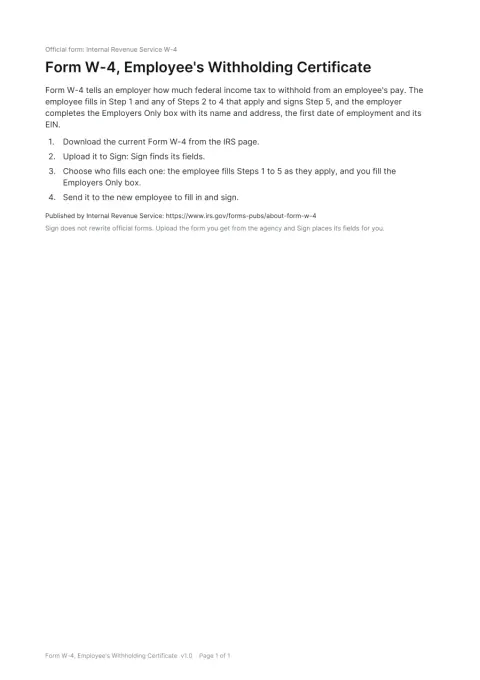
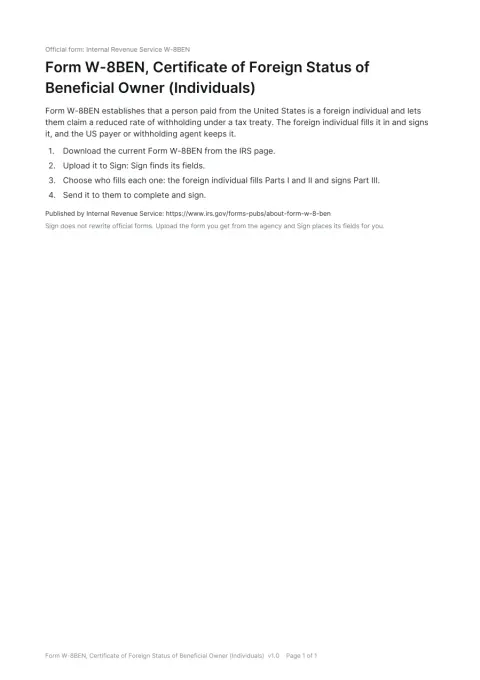
For payees who are US persons, including US resident aliens, under US federal tax law. Not for foreign persons, who give a Form W-8 instead (Form W-8BEN for an individual), and not for state tax forms.

A CAREFUL CHECK

Before you rely on it

Original Centilio wording, not legal advice. A substitute Form W-9 under Internal Revenue Code section 3406 and Rev. Proc. 83-89, as amplified by Rev. Proc. 96-26. It follows Form W-9 (Rev. March 2024), and the lead-in and items 1 to 4 of the Part II certification are copied word for word from that revision. The certification instructions follow the IRS text, pointing to the IRS instructions online. The payee must cross out item 2 (here, by ticking the box under the certification) when the IRS has told them they are subject to backup withholding for underreporting interest or dividends, and if the IRS tells you that about a payee, you must tell the payee to do it. Line 3a is a typed answer instead of seven boxes, and the TIN goes in one box with its type. The only signature covers the certifications. For an electronic W-9 the IRS also expects the system to confirm who the payee is, keep a record of each submission and give a paper copy on request (Announcement 98-27). It does not cover backup withholding itself, TIN matching, state forms or foreign payees. Check www.irs.gov/FormW9 for a newer revision before you approve it, and ask a tax adviser about anything unusual.