centilio
Centilio

Explore the products

A business OS.
Room to grow.

Start with one tool. Explore the wider suite as your needs grow.

Explore Centilio One ↗Product availability follows the catalogue.
FREE TEMPLATE / REAL ESTATE AND PROPERTY

General Warranty Deed

A general warranty deed for real property in any US state. The grantor conveys the property and promises good title, the right to convey, freedom from encumbrances except those listed, and quiet possession, and will defend the title against all lawful claims. It is signed before a notary, with witnesses where the state requires them, and then recorded in the county.

For the United States.

This page lists how to sign it in the United States. See how it is signed

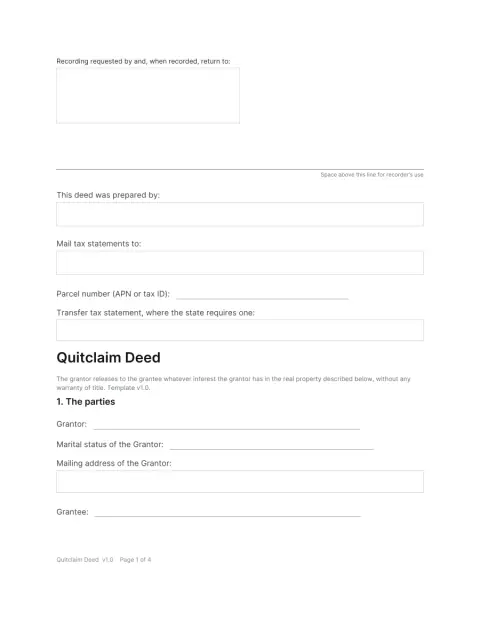
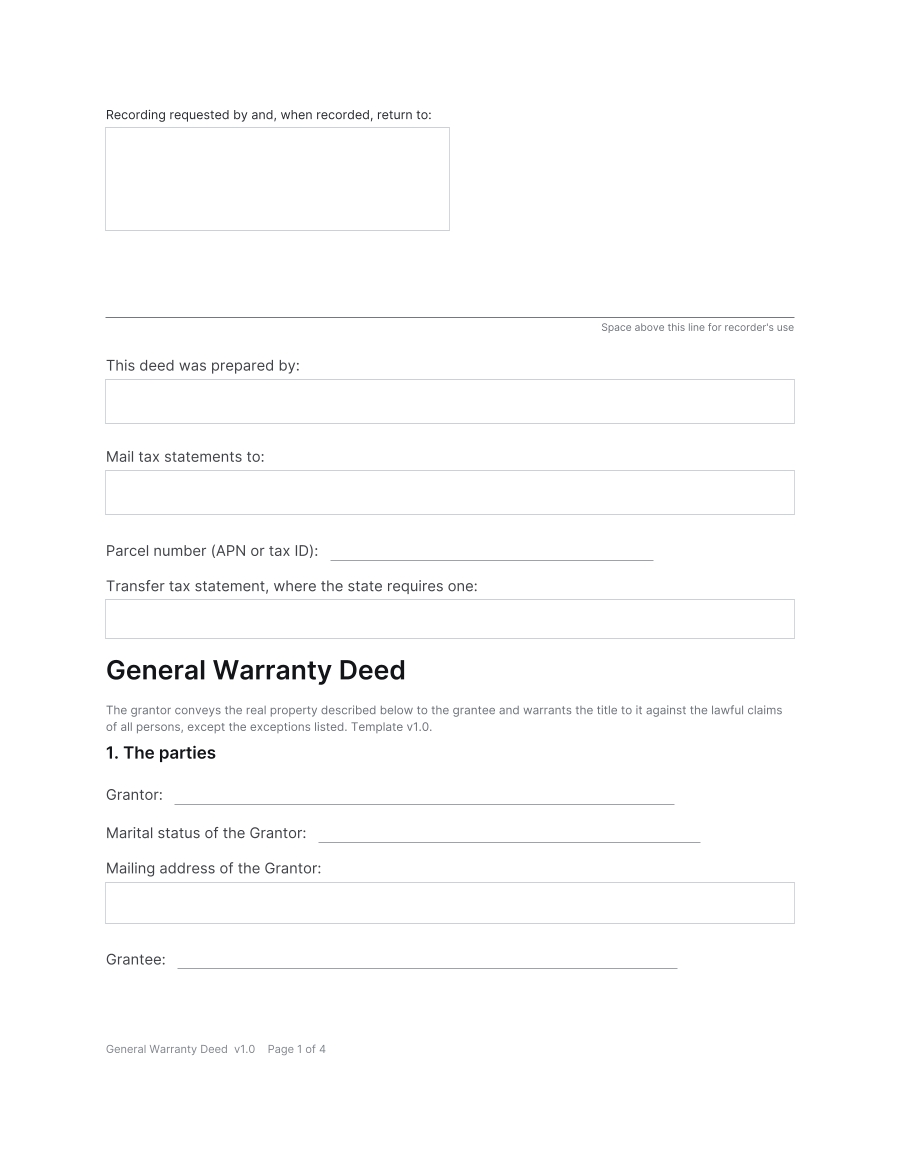
First page of the General Warranty Deed template
PDF, 4 pages, 16 KB
THE DOCUMENT

What it covers

The template has 6 parts.

  1. The parties
  2. The property
  3. Conveyance
  4. Exceptions
  5. Warranties of title
  6. Signatures
BEFORE YOU START

What you will be asked

Have these details ready. The template needs them before anyone signs.

  • Which state is the property in?
  • Which county is the property in?
  • What is the street address of the property?
  • Who is conveying the property? Give each full name exactly as it appears on the current deed.
  • Is the grantor married or single? If there is more than one grantor, say it for each.
  • What is the grantor's mailing address?
  • Who is receiving the property? Give each full name.
  • What is the grantee's mailing address?
  • How will the grantees hold title? For example as joint tenants with right of survivorship, or as tenants in common.
  • What is the price or other consideration? Give the amount, or say love and affection if it is a gift.
  • What is the legal description of the property? Copy it word for word from the current deed.
  • What does the grantee take the property subject to, such as easements of record or this year's property taxes? Say none if there is nothing.
  • What is the parcel number on the property tax bill? It may be called the APN, PIN or tax ID. You can skip it and write it in later.Optional
  • Does your state need a transfer tax statement on the deed itself, such as the tax due or the exemption claimed? Say it, or skip.Optional
  • Who prepared this deed? Give a name and mailing address.
  • After the county records the deed, who should it be mailed back to? Give a name and mailing address.
  • Who should receive the property tax bills from now on? Give a name and mailing address.
THE PEOPLE

Who signs

Everyone the template names, and what each one does.

  • GrantorSigns
  • Second grantor or joining spouse, if anySigns
  • First witness, where the state requiresWitness
  • Second witness, where the state requiresWitness
  • Notary publicNotary
SIGNING RULES

How it is signed in the United States

The rules for a deed transferring property depend on where it is signed. Laws change, so check the sources before anyone signs.

United States

Print and sign in ink

Print it and sign it in ink. A notary or other authorized officer must take the signature. It must then be registered.

Steps

  1. Print the deed on US Letter paper with one inch margins.
  2. The grantor signs before a notary, and before witnesses where the state requires.
  3. File any transfer tax or change of ownership form the state asks for.
  4. Record the deed with the county where the property is.
  5. The recorded deed is mailed to the return address on page 1.

What the law asks for

E-signature
Only in some casesMany counties accept electronic recording of a deed notarised online, through a recording submitter.
Witnesses
NoneMost states need no witness.
Notary
RequiredThe grantor's signature is acknowledged before a notary so the deed can be recorded.
Remote signing
Online notary allowedOnline notarization is in force in 42 states and DC (mid 2026).
Registration
RequiredRecord the deed with the county recorder or clerk where the property is, with its fee and any transfer tax form.
Stamp duty
Not neededSome states charge a transfer tax or ask for a transfer form when the deed is recorded.

Where the rules differ

Signing rules by state in the United States
StateHow it is signedE-signatureWitnessesNotaryRegistrationStamp duty
FloridaPrint and sign in inkOnly in some casesTwoRequiredRequiredRequired
South CarolinaPrint and sign in inkNot acceptedTwoRequiredRequiredRequired

South Carolina has no remote online notarization law in force.

Sources

Checked October 25, 2026 against these sources.
QUESTIONS

Common questions

Answers from the signing rules on this page.

Can the general warranty deed be signed electronically in the United States?

Only in some cases in the United States. Many counties accept electronic recording of a deed notarised online, through a recording submitter.

How many witnesses does the general warranty deed need in the United States?

None. No witness is needed in the United States. Most states need no witness.

Does the general warranty deed need a notary in the United States?

Yes. A notary or other authorized officer must take the signature. The grantor's signature is acknowledged before a notary so the deed can be recorded.

Does the general warranty deed need to be registered in the United States?

Yes. It must be registered. Record the deed with the county recorder or clerk where the property is, with its fee and any transfer tax form.

Is stamp duty due on the general warranty deed in the United States?

No stamp duty is due. Some states charge a transfer tax or ask for a transfer form when the deed is recorded.

Can the general warranty deed be signed or witnessed remotely in the United States?

Yes. Online notarization is allowed. Online notarization is in force in 42 states and DC (mid 2026).

Can the general warranty deed be signed electronically in Florida?

Only in some cases in Florida.

How many witnesses does the general warranty deed need in Florida?

Two witnesses.

Does the general warranty deed need a notary in Florida?

Yes. A notary or other authorized officer must take the signature.

Does the general warranty deed need to be registered in Florida?

Yes. It must be registered.

Is stamp duty due on the general warranty deed in Florida?

Yes. Stamp duty is paid before it is signed.

Can the general warranty deed be signed electronically in South Carolina?

No. An electronic signature is not accepted for it in South Carolina. South Carolina has no remote online notarization law in force.

How many witnesses does the general warranty deed need in South Carolina?

Two witnesses.

Does the general warranty deed need a notary in South Carolina?

Yes. A notary or other authorized officer must take the signature.

Does the general warranty deed need to be registered in South Carolina?

Yes. It must be registered.

Is stamp duty due on the general warranty deed in South Carolina?

Yes. Stamp duty is paid before it is signed.

THE RIGHT TEMPLATE

Where it fits

For real property in any US state except Louisiana, which uses its own civil law forms. Its warranty covers the title against everyone, while a special warranty deed covers only the grantor's own time as owner and a quitclaim deed gives no warranty at all. In California a grant deed is the usual deed for a sale. Sign prepares it to print on US Letter: the grantor signs in ink before a notary and before any witnesses the state requires, such as two in Florida and Connecticut or one plus the notary in Georgia, and the deed is then recorded with the county recorder.

A CAREFUL CHECK

Before you rely on it

Original Centilio wording, not legal advice. The deed and recording statutes of the state where the property is apply, such as Florida Statutes section 689.01, which needs two witnesses. The grantor answers for any defect in title not listed as an exception, so a title search and title insurance are advised. It conveys the whole ownership in fee simple and does not cover paying off or assuming a mortgage, seller financing, a trust, company or estate as grantor, or signing by power of attorney. It has one grantor signature: where two owners convey, or a spouse must join, as community property and homestead states may require, each must sign and be acknowledged, so ask a lawyer. Many states need forms filed with the deed, such as California's preliminary change of ownership report or New York's TP-584 and RP-5217, and some need statements on the deed, such as Oregon's land use statement. See a real estate lawyer or title company before signing. Every owner on the current deed signs, and so does a spouse where the state requires a spouse to join (homestead and community property states): the second signature column is for that person and stays blank otherwise. In Georgia the notary also signs as the official witness, and the notary uses the certificate wording of the state where the deed is signed.