centilio
Centilio

Explore the products

A business OS.
Room to grow.

Start with one tool. Explore the wider suite as your needs grow.

Explore Centilio One ↗Product availability follows the catalogue.
Centilio SignFeatherstroke
FREE TEMPLATE / PERSONAL, FAMILY AND LEGAL

General Power of Attorney (India)

A general power of attorney for India on e-stamp paper. The principal appoints an attorney to manage property, operate bank accounts, deal with government offices, sign and file papers, pay taxes and file returns, and engage advocates, but not to sell, gift or mortgage immovable property unless a further power says so. It is signed before two witnesses and attested by a notary.

For India.

This page lists how to sign it in India. See how it is signed

PERSONAL, FAMILY AND LEGAL / FREE TEMPLATEGeneral Power of AttorneyNamePrincipal's full nameFather's or husband's namePrincipal's father's or husband's nameAge in yearsPrincipal's age in yearsPrincipalSignature: Ready
PDF, 3 pages, 15 KB
THE DOCUMENT

Read it, fill it in, print it

The whole document, exactly as it prints. Type your answers and they appear in the document as you go. When it reads right, print it or save it as a PDF. Then sign it the way the signing rules below describe.

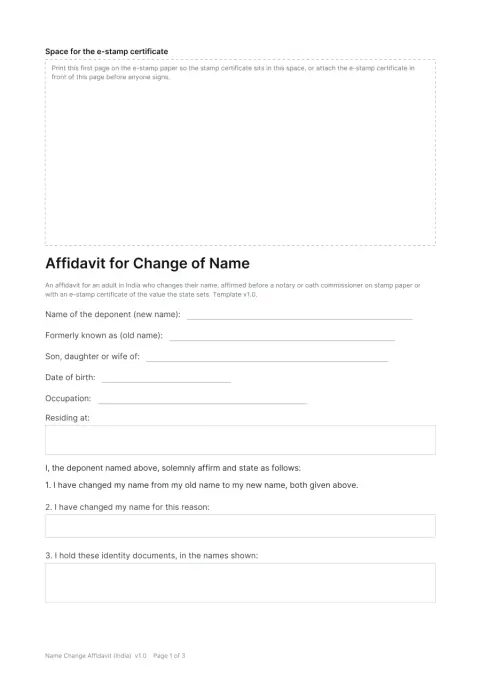
Space for the e-stamp certificate

Print this first page on the e-stamp paper so the stamp certificate sits in this space, or attach the e-stamp certificate in front of this page before anyone signs.

General Power of Attorney

A general power of attorney for use in India, on e-stamp paper of the value the state requires, signed before two witnesses and attested by a notary. Template v1.0.

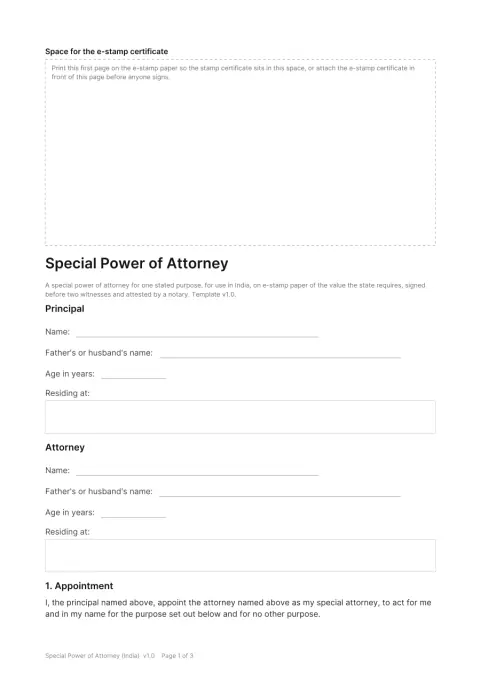
Principal

Name: Principal's full name

Father's or husband's name: Principal's father's or husband's name

Age in years: Principal's age in years

Residing at:

Principal's address

Attorney

Name: Attorney's full name

Father's or husband's name: Attorney's father's or husband's name

Age in years: Attorney's age in years

Residing at:

Attorney's address

1. Appointment

I, the principal named above, appoint the attorney named above as my general attorney, to act for me and in my name in the matters set out below.

2. Powers

My attorney may:

  1. Manage, look after and maintain my movable and immovable property, pay property tax, electricity, water and maintenance charges, carry out repairs, and let my property on rent or leave and licence for up to 11 months at a time, collecting the rent and deposits.
  2. Operate my bank and post office accounts, deposit and withdraw money, sign cheques and other bank papers, and receive statements and the proceeds of deposits on maturity, as each bank or post office allows.
  3. Appear for me before any central, state or local government office, municipal body, revenue office, sub-registrar or other authority, and apply for, sign for and receive any certificate, licence, permission, record or mutation.
  4. Sign, submit and receive applications, forms, letters, receipts and other papers needed for these matters.
  5. Pay income tax, property tax and other taxes and dues, file returns and appear before tax authorities for me, as the tax laws allow.
  6. Engage advocates and other professionals, sign vakalatnamas, and start, defend, pursue, compromise or withdraw cases and proceedings about my property and affairs before any court, tribunal or authority.
  7. Do every other lawful act reasonably needed to carry out these powers.

3. Immovable property

This power of attorney does not authorise my attorney to sell, gift, mortgage, exchange or otherwise transfer any immovable property of mine, or to sign any agreement to do so, unless the further powers below expressly say so.

Further powers, if any:

Further powers

4. Ratification

I agree to ratify and confirm everything my attorney lawfully does or causes to be done under this power of attorney, as if I had done it myself.

5. Revocation

I may revoke this power of attorney at any time by written notice to my attorney. It also ends on my death and in the other cases the law provides. A person who deals with my attorney in good faith, without knowing that it has ended, may rely on it.

Execution

Executed at: Place of execution

State: State of execution

Signed by the principal on the date below.

PrincipalSignatureNameDate

Signed by the principal named above in our presence.

First witnessSignatureNameDateAddress and occupation
Second witnessSignatureNameDateAddress and occupation

Notarial attestation

Notarial certificate

For the notary public only. The notary completes or attaches the notarial certificate here.
THE DOCUMENT

What it covers

The template has 9 parts.

  1. Principal
  2. Attorney
  3. Appointment
  4. Powers
  5. Immovable property
  6. Ratification
  7. Revocation
  8. Execution
  9. Notarial attestation
BEFORE YOU START

What you will be asked

Have these details ready. The template needs them before anyone signs.

  • What is your full name?
  • What is your father's name, or your husband's name if you are a married woman?
  • How old are you?
  • What is your full home address, with the PIN code?
  • Who will be your attorney? Give their full name.
  • What is your attorney's father's name, or her husband's name if she is a married woman?
  • How old is your attorney?
  • What is your attorney's full address, with the PIN code?
  • Do you want to give any further power, such as selling or mortgaging a particular property? Describe it, or say none.Optional
  • In which town or city will you sign it?
  • In which state or union territory will you sign it?
THE PEOPLE

Who signs

Everyone the template names, and what each one does.

  • PrincipalSigns
  • First witnessWitness
  • Second witnessWitness
  • NotaryNotary
SIGNING RULES

How it is signed in India

The rules for a power of attorney for property and money depend on where it is signed. Laws change, so check the sources before anyone signs.

India

Print and sign in ink

Print it and sign it in ink in front of two witnesses, who sign it too. A notary or other authorised officer must take the signature. Stamp duty is paid before it is signed.

Steps

  1. Buy e-stamp paper for the state's stamp duty, or print on stamp paper.
  2. Print the power of attorney on it.
  3. Sign before two witnesses and a notary.
  4. Register it with the sub-registrar if it covers sale of property.

What the law asks for

E-signature
Not acceptedThe Information Technology Act First Schedule leaves powers of attorney out, so sign on stamp paper.
Witnesses
TwoTwo witnesses sign, with their names and addresses.
Notary
RequiredA notary attests the execution. A power to sell immovable property must be registered.
Remote signing
Not available
Registration
OptionalRegistration with the sub-registrar is needed when it authorises sale, gift or mortgage of immovable property.
Stamp duty
RequiredStamp duty depends on the state and is higher when the power covers sale of immovable property. Buy e-stamp paper for the state's amount.

Sources

Checked 25 October 2026 against these sources.

QUESTIONS

Common questions

Answers from the signing rules on this page.

Can the general power of attorney be signed electronically in India?

No. An electronic signature is not accepted for it in India. The Information Technology Act First Schedule leaves powers of attorney out, so sign on stamp paper.

How many witnesses does the general power of attorney need in India?

Two witnesses. Two witnesses sign, with their names and addresses.

Does the general power of attorney need a notary in India?

Yes. A notary or other authorised officer must take the signature. A notary attests the execution. A power to sell immovable property must be registered.

Does the general power of attorney need to be registered in India?

No. Registration is optional. Registration with the sub-registrar is needed when it authorises sale, gift or mortgage of immovable property.

Is stamp duty due on the general power of attorney in India?

Yes. Stamp duty is paid before it is signed. Stamp duty depends on the state and is higher when the power covers sale of immovable property. Buy e-stamp paper for the state's amount.

Can the general power of attorney be signed or witnessed remotely in India?

No.

THE RIGHT TEMPLATE

Where it fits

For a principal in India who wants a family member or other trusted person to look after their affairs. It gives no power to sell, gift or mortgage immovable property unless the further powers say so, and such a power needs registration and higher stamp duty. Use the special power of attorney for one task.

A CAREFUL CHECK

Before you rely on it

Original Centilio wording, not legal advice. A general power of attorney under the Powers of Attorney Act 1882 and the agency rules of the Indian Contract Act 1872, printed on or attached to e-stamp paper of the value set by the state's stamp law (Article 48 of Schedule I to the Indian Stamp Act 1899, or the state's own Act) and attested by a notary under the Notaries Act 1952. It gives no power to sell, gift or mortgage immovable property unless the further powers say so, and such a power must be registered with the sub-registrar where the property is: several states make registration compulsory, buyers and banks expect it everywhere, and it is stamped at a higher rate. It ends on the principal's death, or if the principal becomes of unsound mind (Indian Contract Act section 201), and can be revoked by notice. Banks and the income tax department may require their own forms or limit what an attorney can sign. A power signed abroad must be attested as the law there or an Indian consulate requires and stamped within three months of reaching India. See an advocate before giving powers over property or appointing someone outside the family.